

When launching a cashback rewards program, the instinct is often to treat it like a slow build. Companies get it live, then ramp up marketing over time.
It's a reasonable approach. But it can leave a lot of growth potential on the table.
Here's what we've learned after working with dozens of partners on rewards program launches: the customers you activate early are disproportionately more valuable than the ones you activate later.
And if you're not deploying incentives right out of the gate, you could be missing the activation of your highest-LTV users.
Early Engagement Is a Rewards Program Growth Multiplier
We published research showing that program members who make their first purchase within 30 days of enrolling tend to generate 2.4x higher ARPU than those who wait longer. That reflects a fundamentally different relationship with the program.
Users who transact quickly aren't just more active in the short term. They experienced the benefit firsthand. They built the habit. So, they're far more likely to keep coming back.
The strategic implication is: anything you can do to get users to that first transaction faster pays compounding dividends over the life of the program.
Most Rewards Program Launch Plans Don't Take Full Advantage of This
Our clients work hard to build a foundation of regular rewards program marketing best practices: relentless, multi-channel messaging appropriately segmented to the members’ lifecycle(s).
But one lever that often gets underutilized at program launch is the use of incentives.
Think of it like this: marketing communicates the existence of the program, but incentives quickly demonstrate its value. They give customers a concrete reason to enroll and transact right now, rather than filing it away for later.
Front-loading spending on incentives (concentrating the highest-value offers in the first weeks and months of a program) changes the trajectory of a program's growth from the very start.
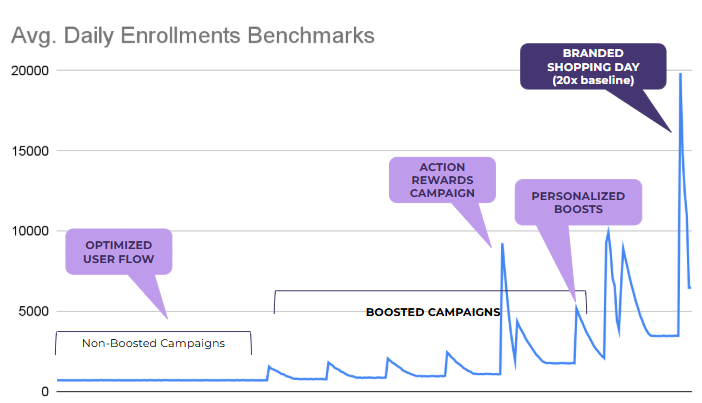
The below chart illustrates the impact of promotional efforts well after a program launches. Imagine the impact if the incentives were front-loaded?
What Front-Loaded Rewards Incentives Look Like in Practice
Wildfire offers several tools that our clients can deploy as part of a launch incentive strategy:
-
Action Rewards (offering a First Purchase bonus). Action Rewards is a Wildfire feature that enables incentives such as a cash bonus for users who make their first purchase within “x days of enrollment.” This is the most direct lever for driving early activation. Clients offering enrollment bonuses see enrollment growth of 700–900%. The time-bound nature of the offer is part of what makes it work, since a clear deadline triggers action in a way that open-ended offers don't.
-
Boosted Offers. Wildfire's Boosted Offers let clients elevate cashback rates at popular merchants. (Think 3x, 5x, or 10x the standard rate for a limited time.) When deployed at launch, they do double duty: they attract new enrollments and they give recently enrolled users an immediate, high-value reason to make that first purchase. In a case study with a major financial institution, Boosted Offers campaigns drove a 48% increase in rewards program enrollments, and a 756% increase in orders at boosted merchants. Finally, the campaign reduced the average time to first purchase to just one day for users who enrolled during the Boosted Offers periods.
-
Branded Shopping Day. A high-impact, limited-time shopping event with compelling boosted rates across popular merchants can be positioned as a launch moment, with teaser campaigns building anticipation in the week prior. The increase in enrollments looks like a spike, but the real value is what happens afterward: each of these spikes actually raises the floor for average daily enrollments over time.
The Logic of Front-Loading Program Incentives
There's a temptation to spread incentive budget evenly across a program's lifecycle, or to hold it in reserve for re-engagement campaigns later.
That's not wrong. Re-engagement has real value (the Boosted Offers case study showed 33% of purchasers during the campaign were previously inactive users). But it has the potential to miss the compounding effect of early activation.
You might think about it this way:
-
Over a year’s time, a user who activates in week one has 52 weeks to generate revenue.
-
A user who activates in month six has six fewer months of engagement and habit-building through their activity in the program.
Front-loading actually accelerates the revenue curve. It doesn't just shift money around.
The programs that grow fastest aren't the ones that wait to prove value. They're the ones that deliver it immediately, loudly, and in a way customers can feel in their wallet.