




With margin pressure from increasing customer acquisition and retention costs, banks are increasingly focusing on improving their unit economics to optimize profitability and ensure sustainable growth. In this article, we’ll explore the significance of unit economics for financial institutions and discuss how cashback rewards programs can be a powerful tool for banks to enhance customer value while positively impacting a bank’s own bottom line.
Unit economics are a way to evaluate on a per customer basis whether a company is generating more revenue, either annually or on a lifetime basis, than it costs to acquire and retain a customer.
How can banks improve customer unit economics?
Banks can improve customer unit economics by increasing revenue per customer, reducing customer acquisition and retention costs, and creating additional sources of revenue from existing customer relationships. Cashback rewards programs can support these goals by increasing customer engagement and purchase activity while generating merchant-funded revenue for the financial institution.
What are unit economics and why are they important for Financial Institutions (FIs)?
Unit economics refer to the direct revenues and costs for a business, calculated on a per-unit basis. The easiest way to calculate unit economics is by using the revenue per customer and dividing it by the cost per customer, which includes costs like acquisition cost, retention cost, etc. It typically requires analyzing the core building blocks of operations, revenue generation, and overhead to assess the financial viability of each customer or transaction.
For FIs, understanding unit economics is crucial because they can clearly reflect insights like profitability in customer or product segments, and identify areas for improvement. Improving unit economics ultimately means increasing the value generated by each customer relationship while continuing to provide benefits that customers value.
Some key unit economics metrics for FIs
- Revenue per Customer: The total revenue generated from a customer, including interest income, fees, and other services utilized.
- Lifetime Value (LTV): The predicted net profit a customer is expected to generate throughout their relationship with the FI.
- Customer Acquisition Cost (CAC): The expenses associated with acquiring new customers, such as marketing and sales costs.
- Churn Rate: The percentage of customers who discontinue their relationship with the bank over a given period.
How can FIs add customer value while improving unit economics?
To keep unit economics strong, FIs need to satisfy customers’ wants and needs to reduce churn and improve revenue-per-customer.
One common way FIs do this is through cross-selling. Cross-selling is when an existing customer purchases an additional, often adjacent, product. For example, an FI customer with a checking or savings account and credit card could use the same FI for their home mortgage.
Cross-selling is an effective way to improve unit economics because it directly increases the revenue per customer, but has minimal additional customer acquisition cost, thereby driving the FI’s overall margin up.
Cross-selling for FIs also builds customer value because it is key to creating a cohesive customer journey and experience and minimizes friction.
For example, that same FI customer with a checking or savings account, credit card, and now a home mortgage can do a direct deposit from their checking account back to the FI to pay the monthly mortgage payment without having to think about it (let alone transfer money between accounts).
Another way FIs increase customer value and improve unit economics is by introducing new products and programs that their customers want.
For example, introducing products like credit cards that have high cashback rates in categories that their customers typically buy (like groceries). This builds value for the customer through additional cashback, and will improve the FI’s unit economics when the customer continues to use that credit card for additional purchases, increasing their purchase volume.
Unit economics improve when the revenue outweighs the cost of the program.
How can banks monetize customer engagement?
Banks can monetize customer engagement by creating revenue opportunities around activities customers already value, such as shopping and earning rewards. Merchant-funded cashback programs can generate commissions when customers make eligible purchases, allowing banks to share some of that revenue with customers as cashback while retaining the remainder as incremental revenue.
Addressing customer demand for value and savings
In today’s uncertain economic climate, customers are seeking greater value for their money. Our recent whitepaper illustrated the ways consumer shopping behavior is changing, indicating a greater inclination to make their budgets last longer.
Consumers are changing when they shop (more shopping during sales,) where they shop (more shopping at discount retailers), and how they shop (using money-saving tactics such as loyalty program discounts and cashback rewards programs via browser extensions).
In fact, 75% of consumers said they were more interested than ever before in earning rewards for shopping because of inflation and the uncertain economy.
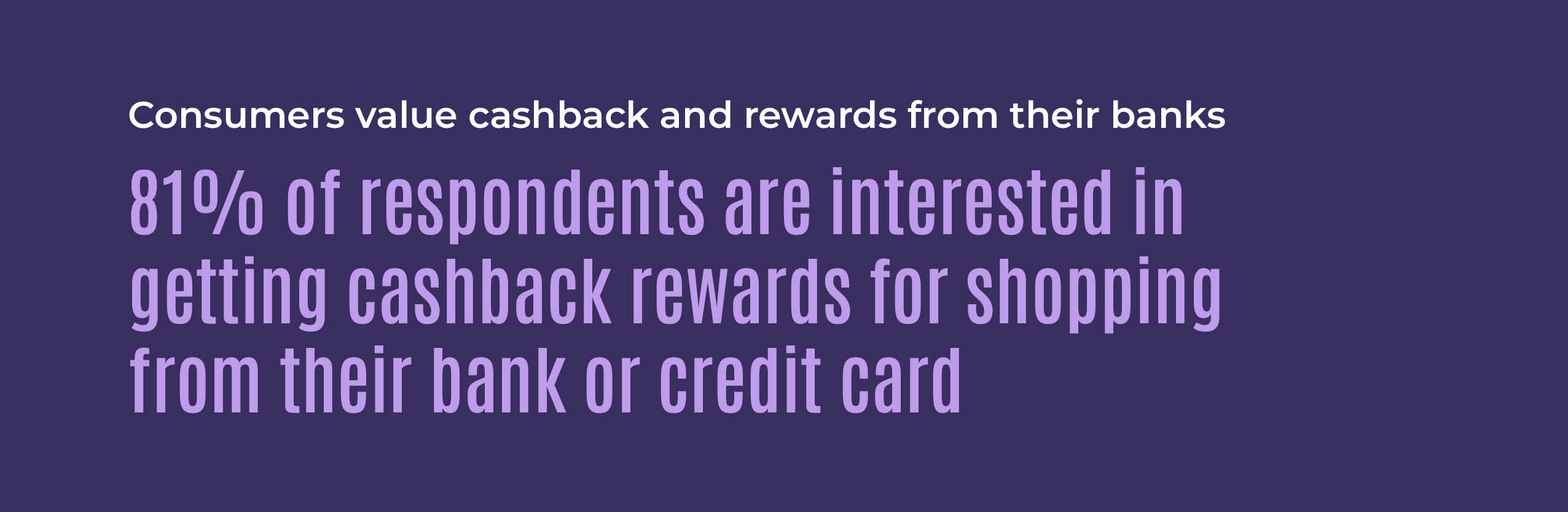
FIs can respond to the consumer savings mindset and increased demand for money-saving tactics by actually offering cashback shopping rewards to their customers. Our survey also showed that 81% of respondents are interested in getting cashback rewards for shopping from their bank or credit card.
This creates an opportunity for banks to align customer value with their own economics: customers receive savings and rewards they actively want, while the financial institution can generate revenue from the shopping activity those rewards encourage.
How cashback rewards improve bank unit economics
Shopping rewards programs’ funding model relies on merchants’ affiliate marketing budgets rather than the FIs’ own budgets.
Therefore, these programs will improve an FI’s unit economics because the revenue typically far outweighs the minimal costs, which typically include platform technology and marketing costs.
Cashback rewards can improve bank unit economics when the program generates more revenue than it costs to operate. Merchant-funded commissions provide the underlying revenue source, allowing banks to offer customers cashback while retaining a portion of the resulting revenue.
Here is how it works:
- On average, an eligible purchase will earn 6% cashback, which is funded by the merchant.
- From that 6% commission, the platform keeps a small percentage and the FI will receive the rest.
- Then, the FI will typically pass back half of their commission received to the customer, providing consumers with the benefits they want.
- The FI keeps the remaining commission.
Because the commissions are paid from merchants, they create a net new revenue stream for the FI.
Across all of our partners, we have seen that shopping rewards are net-positive on an FIs’ unit economics basis because the revenues generated from each customer far outweigh the platform and marketing costs per customer.
The result is a rewards model in which merchant-funded shopping activity can create incremental revenue for the financial institution while funding customer rewards.
Can cashback rewards create new revenue for banks?
Yes. Merchant-funded cashback rewards can create a new revenue stream for banks by generating commissions on eligible customer purchases. A portion of that revenue can be returned to customers as cashback while the bank retains the remainder. When revenue generated by the program exceeds its technology and marketing costs, cashback rewards can contribute positively to customer-level profitability while also increasing customer engagement.
Conclusion
As FIs work to improve their unit economics in the current uncertain economic setting, cashback rewards programs can be seen as a strategic and effective solution. These solutions align customers’ search for value with the institution's profitability, ultimately driving customer engagement and increasing revenue per user.
Implementing such programs requires careful planning, analysis, and collaboration across different departments within the FI, along with ongoing tracking and monitoring. As FIs consider leveraging cashback rewards programs to enhance their unit economics, they must carefully evaluate customer demand, funding models, and potential pitfalls, ensuring a seamless and rewarding experience for both the FI and its valued customers.